


“That’s cute, honey, but that’s not going to work for our business.”
That’s what a marketing director said to me when I suggested Pinterest. They dismissed it without a second thought. Without testing it. Without even checking if their audience was there.
They’re out of business now.
Maybe they should’ve tried Pinterest.
Here’s What Most Marketers Get Wrong
Most marketers think Pinterest is for DIY crafts and wedding planning.
They dismiss it as “not serious.” Or “not for B2B.” Or my personal favorite: “My audience isn’t on Pinterest.” (Without ever actually checking.) But here’s what Pinterest actually is: a search engine with 578 million monthly active users.
Not social media.
Want to learn how to build an audience that actually converts? Read my guide on connecting with your dream customers.
Why Pinterest Is Different From Every Platform You’re Using
Your content doesn’t disappear in 24 hours.
One pin can drive traffic for 12+ months. People aren’t passively scrolling for entertainment—they’re actively searching for solutions. 96% of Pinterest searches are unbranded. Meaning people are looking for answers, not specific companies.
They’re in shopping mode. Ready to take action.
And here’s the kicker: Pinterest users spend 2x more per month shopping than users on other platforms.
The Real Numbers
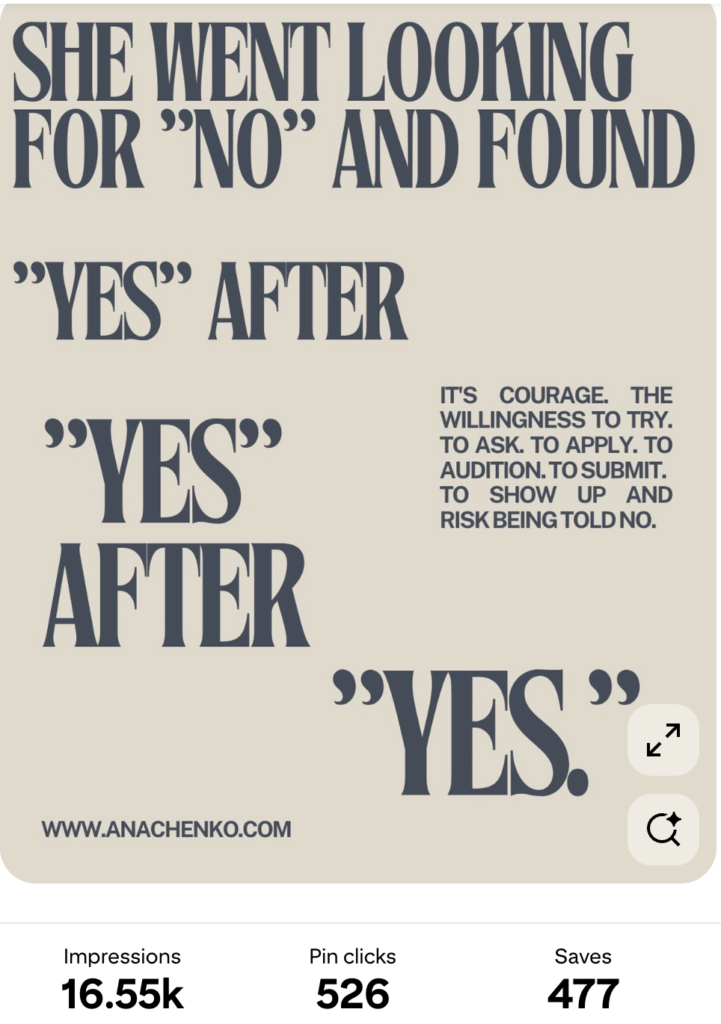
Let me show you what one pin did for me:
- 16.55k impressions
- 526 clicks to my website
- 477 saves (meaning it’ll resurface again and again)
And this isn’t a viral fluke. This is what Pinterest does when you understand how it works.
Users are 3x more likely to click through to your website from Pinterest than from other social platforms. 46% of Pinterest users have discovered a new brand or product on the platform.
And Pinterest ads? 2.3x cheaper per conversion than other social media.
Ready to turn traffic into revenue? Learn my content strategy framework here.
What Makes Pinterest So Effective
Pinterest works because it captures people at a different stage of the buyer journey.
On Instagram and TikTok, people are killing time. They’re not looking to buy. They’re looking to be entertained. On LinkedIn, people are networking or job hunting. They might read your thought leadership, but they’re not ready to pull out their credit card.
On Pinterest? People are planning, researching, and ready to commit.
They’re searching for “best email marketing tools for small business,” or “how to create a lead magnet,” or “content marketing strategy template.” They want answers. They want solutions. They want to take action.
And when your pin shows up in their search results, you’re not interrupting them—you’re helping them.
Compare That to Your Instagram Post
Your average Instagram or LinkedIn post is dead in 48 hours.
Maybe 72 if you’re lucky. Pinterest? Still working while you sleep.
You can drive traffic to your website, lead magnets, newsletter sign-ups, direct offers, course launches—any page that needs eyeballs.
And the best part? Way less competition than Instagram, TikTok, or LinkedIn. Because everyone’s chasing the shiny platforms while ignoring the one that actually converts.
Need help crafting copy that converts visitors into customers? Explore my copywriting services.
What You Can Actually Do With Pinterest
Here’s what works:
Educational content. How-to guides, tutorials, frameworks, templates. Pinterest users are actively learning.
Visual resources. Infographics, checklists, worksheets, planners. If it solves a problem visually, it performs.
Product launches. New courses, digital products, services. Pinterest users are buyers, not browsers.
Lead magnets. Free downloads, email opt-ins, webinar registrations. Pinterest traffic converts.
Blog content. Long-form articles, case studies, deep dives. One pin can drive traffic for years.
The key? You’re not trying to go viral. You’re trying to show up when someone searches for what you offer.
Want to see how I use content to build authority? Check out my blog for more strategies.
The Long-Term Advantage
Here’s the part most marketers miss: Pinterest compounds.
Post on Instagram today? It’s gone tomorrow.
Pin on Pinterest today? It’s still driving traffic next month. Next quarter. Next year.
Every pin you create becomes a permanent asset. It keeps working. It keeps compounding. It keeps bringing people to your website without you lifting a finger.
You’re not trading time for reach. You’re building a library of evergreen content that works for you indefinitely. That’s the difference between a platform that exhausts you and a platform that scales you.
So Why Do Marketers Keep Ignoring It?
No instant gratification. It’s not sexy. Results compound over time instead of exploding overnight. It requires a different strategy.
And honestly? Ego.
Admitting you were wrong is hard. Admitting you overlooked something “cute” is harder. That marketing director chose ego over strategy. They wanted to feel smart by chasing the platforms everyone talks about at conferences.
They wanted to post on LinkedIn and get likes from their peers. They didn’t want to do the unsexy work of building a traffic engine that actually converts.
So they stuck with what felt impressive. Not what worked.
You Have Two Options
You can ignore Pinterest, too. Or you can test it before dismissing it.
Create 10 pins. Drive them to your best content. Track the traffic. See what converts. Give it 90 days. That’s all. And if it doesn’t work (at first), you lose nothing.
If it does? You just found a traffic source your competitors are too proud to touch.
Want help building a content strategy that actually drives results? Let’s work together.
Pinterest isn’t going anywhere. But your competitors might be.
Anastasiya
– Premium Ghostwriter
Need Content That Converts?
I’m Anastasiya, a ghostwriter and copywriter who helps founders, entrepreneurs, and thought leaders turn big ideas into content that sparks movements and drives results.
If you’re ready to build a content strategy that works as hard as you do—whether it’s articles, LinkedIn posts, newsletters, or full campaigns—I’d love to help you bring your vision to life.
Connect with me here to discuss how we can work together.


